


Local Land Banks Are Economic Game Changers Across Michigan, New Report Finds
- The Chronicle News

- 1 day ago
- 5 min read
Local Land Banks Are Economic Game Changers Across Michigan, New Report Finds
Study finds land banks prevented tens of thousands of vacancies and generated billions of dollars in community benefits over 20 years
MICHIGAN — A new study reveals that local land banks are economic game changers across Michigan, in the state’s cities, rural communities and everywhere in between.
The findings show that land banks improve neighborhoods and commercial corridors, decrease vacancies, increase population and positively impact the communities they serve. The new report quantifies the collective impact of Michigan land banks for the first time, examining their first 20 years of operation. Land banks began forming in Michigan in 2004 following the passage of state enabling legislation.
20 Years of Impact Across Michigan
According to the report, over the past 20 years, local land banks in Michigan have:
Handled more than 159,668 properties, representing approximately one of every 20 properties in Michigan.
Prevented at least 45,000 vacancies, reducing the statewide number of vacant properties by 27%.
Generated more than $4.5 billion in community benefits, including $2 billion in investment in vacant properties and at least $719 million in increased property tax revenue supporting local schools and services.
Potentially generated total benefits exceeding $8.6 billion.
Created more than $11 in local community benefits for every $1 of direct funding.
Helped decrease local vacancy rates and increase population, despite often operating in communities facing greater challenges in both areas than statewide averages.
The report, Game Changers: Rebuilding Michigan’s Cities, Rural Communities and Everywhere in Between, was commissioned by the Michigan Land Bank Association as Michigan reached the 20-year anniversary of its land bank system.
“Land banks have spread and evolved over the last 20 years. I witnessed this evolution during my time as the Benzie County Treasurer and Land Bank Executive Director,” said Michelle Thompson, Executive Director of the Michigan Land Bank Association. “Land banks aren’t well known or understood. With this report, we want to improve that.”
Thompson noted that while land banks are often associated with Michigan’s largest urban communities, many operate in smaller and rural areas.
“While land banks are mostly associated with Michigan’s most urban places, most land banks are small and located in less populated and more rural places — places like Benzie County,” Thompson said.
Turning Vacant Properties Into Community Assets
“The results are exciting. Land banks are quiet game changers in Michigan’s economy,” said Natalie Pruett, author of the study. “When they first started forming, one of every ten houses was vacant. The rate is now less than half that. Land banks have been key to that progress.”
Pruett said the impact can often be seen in individual properties that residents may have watched deteriorate for years before finally being restored.
“If you can think of a property that sat vacant for a long time and is now occupied, the odds are that a land bank had something to do with its transformation,” she said.
One of the report’s dominant themes is the similarity between the work of land banks across communities that otherwise vary greatly in population, geography and economic conditions.
“The scenery is a little different between us here in Houghton and the big cities downstate. We have a population of about 38,000 in our entire county. Comerica Park seats more than that. But the land bank stories are so similar,” said Lisa Mattila, Houghton County Treasurer and Land Bank Chair.
“Vacant properties were dragging down the local community — the neighbors, real estate prices, property tax revenue. The land bank stepped in and worked to repurpose them in support of the local community,” Mattila continued. “Finally, after sitting vacant for years, the properties are again reoccupied and contributing to the health of the area.”
Eric Sabree, Wayne County Treasurer and Land Bank Chair, said land banks have also become important tools for economic development and neighborhood stabilization.
“The Wayne County Land Bank, along with other land banks throughout Michigan, has been working diligently to return tax-foreclosed and blighted properties back to productive use,” Sabree said. “The land banks are an essential economic development and neighborhood stabilization vehicle.”
Land Banks Now Serve Millions of Michigan Households
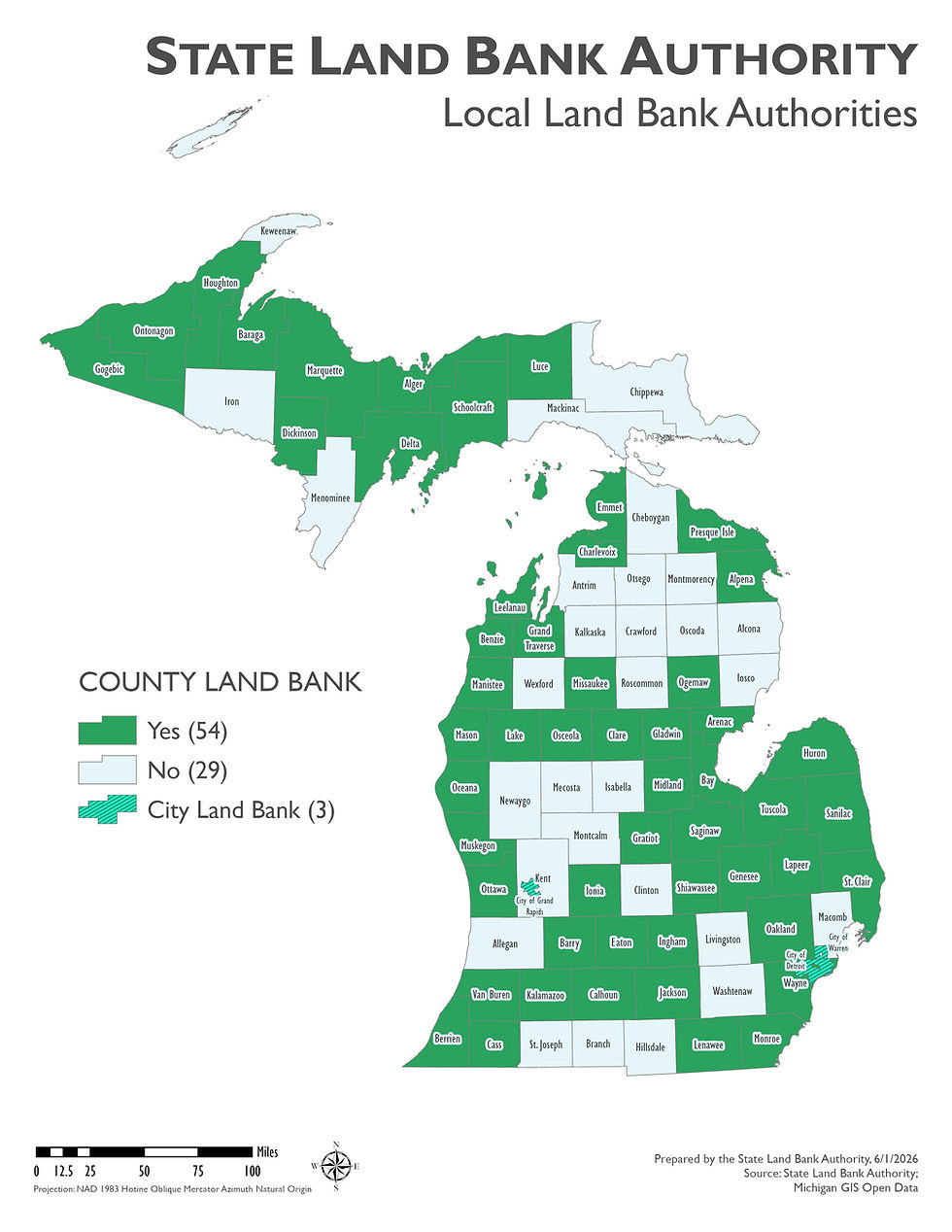
Since the Michigan Legislature passed legislation allowing for the creation of land banks, more than two-thirds of Michigan counties have formed one. Land banks now operate in every region of the state and currently serve approximately 2.7 million Michigan households. “This report confirms what we’ve long known , that Michigan’s local land banks are powerful drivers of economic development,” said Joseph Rivet, Executive Director of the Michigan State Land Bank Authority.
“For the first time, we have statewide data demonstrating their impact, backed by countless success stories , from new housing and revitalized downtown businesses to the redevelopment of former industrial sites and beyond,” Rivet said. “It’s a meaningful milestone that validates the work local land banks are doing every day and reinforces the important role they’ll continue to play in strengthening communities across Michigan.”
Looking Ahead: Housing, Business and Redevelopment
The report’s findings also have implications for Michigan’s future. Land banks present a potentially cost-effective tool for addressing the state’s housing challenges, improving commercial corridors, increasing industrial production and supporting broader community redevelopment.
Michigan land banks currently hold more than 80,000 properties across the state, including thousands of vacant houses and hundreds of vacant commercial buildings. According to the report, rehabilitating a vacant structure typically costs less than half as much as new construction. Even when new infill construction is necessary, vacant lots held by land banks can reduce development expenses because of significantly lower acquisition costs.
Over 20 years, land banks turned approximately $400 million in direct net activity costs into nearly $2 billion in investment in Michigan properties. State and federal funding have been essential components of that investment.
The full 20-year impact report is available through the Michigan Land Bank Association at milandbank.org.
About Land Banks
Michigan has 57 land banks, representing approximately two-thirds of the state’s counties. More than 300 land banks operate nationwide. Land banks are public entities with unique powers designed to return vacant, abandoned and deteriorated properties to productive use in accordance with community goals. Those powers are established under state law and vary from state to state.
When thoughtfully implemented, land banks can address some of the most difficult legal and financial barriers preventing properties from returning to productive use. Their work can help unlock the value of problem properties and transform them into assets for housing, business development and community revitalization.
Michigan’s land bank enabling legislation was passed in 2003 as the Land Bank Fast Track Act, Public Act 258 of 2003. Generally, land banks receive properties that the private market has already rejected. Many properties that remain vacant or abandoned for years accumulate substantial property tax debt and repair costs that exceed their market value. Those financial and legal barriers can discourage responsible private investment and leave properties in limbo for years.
Land banks are specifically designed to overcome those barriers and return properties to productive use, transforming long-neglected properties into assets for neighborhoods and communities across Michigan.


Comments